

Cause 1 — The Wrong Model
Adding an AI Assistant to an online store can enable several new ways for customers to interact with our company: they can ask questions about policies and procedures, they can ask for help finding the perfect product, they can get help with returns and refunds, etc.
Enabling this new path to revenue brings a huge opportunity; however, it also brings risk: poor service that might drive customers away, wrong answers or promises that are legally binding, massive cost spikes driven by untamed token consumption, etc.
Fortunately, technology is evolving to keep these risks under control, while exploring the new opportunities brought on by AI Agents.
For instance, a critical part of our AI Shopping Assistant is determining how to fulfill the user’s request. We saw that in the previous section, when we looked into one of the traces.
One of the ways to optimize token costs is to send each request to the most appropriate model: simple requests should be handled by cheaper models, while more complex or critical tasks should be given to more robust (and expensive) models. Sending a simple task to an expensive model will yield good results, but cost more than necessary; on the other hand, sending a complex task to a simpler model might cause problems and issues (that might require the task to be re-sent to the expensive model).
Part of the development process for our AI Shopping Assistant is to map the different tasks that the agent will be able to execute, and understand which model is more appropriate for the different tasks. One way to do this validation is by leveraging Experiments.
Experiments #
The goal for this section is to find the best LLM to handle the task. For this lab, we have 2 tasks that the agent must perform:
- Answer Q&A questions, which are questions related to policies and procedures, like returns, refunds, loyalty, etc. This usually involves a vector search against a knowledge base.
- Answer Product related questions, such as availability, sizes, price, etc. These require interactions with the product catalog and inventory systems.
Q&A questions are simpler and more straightforward; we expect a simpler, cheaper model to be able to handle them. However, we cannot risk hallucinations or poor responses driving customers away.
Product questions are a lot more critical, because they can lead to a purchase, or drive a potential customer away. These are worth the cost of more robust models, which can provide a more complete and compelling response. Or so we expect.
To put our theories to the test, we can run an experiment: have 2 datasets, one with Q&A questions, and one with Product-related questions. Each dataset contains a curated, representative set of inputs, meant to emulate the type of input that our customers will have, when the agent is running in production. These datasets also include the ‘Ground Truth’, which represents the answer we should expect from the agent; this information gives us a strong understanding of response quality.
Tip
When you implement real-time monitoring with Splunk Agent Observability, you can save real production prompts as a new dataset to validate against new versions of your agent.
Experiments allows us to compare an agentic workload under different conditions: different models, prompts, datasets, retrieval settings, and more. Instead of changing these conditions at once, we run controlled sets of experiments, changing one condition at a time; otherwise, we would not be able to explain the results. In this lab, we will see a simplified version of this iteration, by focusing on the models and tools used to fulfill each type of task.
In this comparison, both experiments received the same 18 product questions. One agent used a simpler (cheaper) model, with its own options for retrieval, while the other agent leveraged the more robust (expensive) model, also with its own retrieval logic. Each LLM determines how to handle each of the 18 prompts that it received.
The experiments are divided into 2 groups:
- Product Model Comparison: evaluates which model is best suited to handle product-related inputs
- Q&A Model Comparison: evaluates how each model handles Q&A questions.
Go to the Experiments page, where we will find the 2 experiment groups.
First, let’s see how the agents handled the Product questions.
Open Experiment Groups > Product Model Comparison.
Before we even compare the experiments, we can see the key results at a glance:
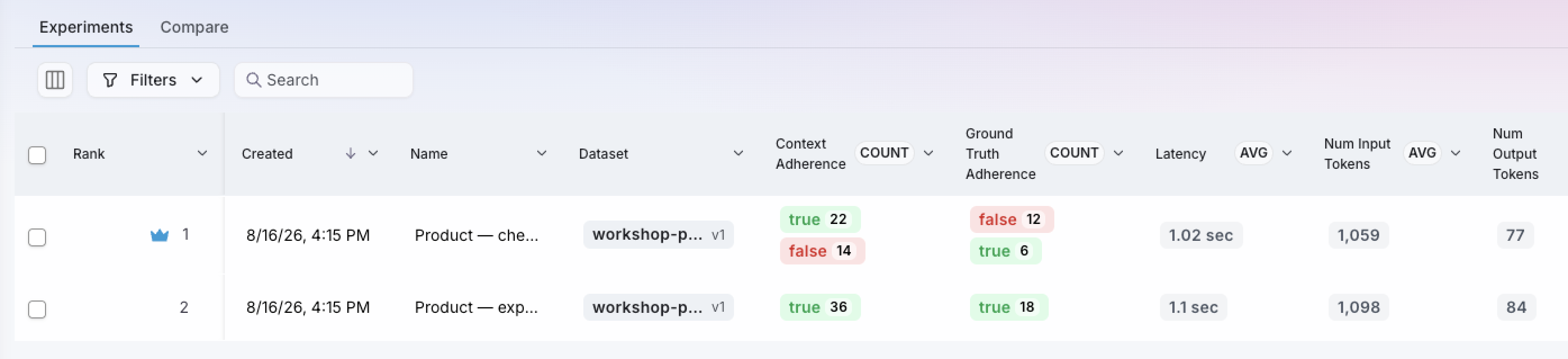
Let’s understand what our key metrics represent for these experiments:
- Context Adherence: Measures how well the response aligns with the provided context. A great eval to detect hallucinations in LLM responses.
- Ground Truth Adherence: Measures how well the response aligns with established ground truth. The datasets we used for the experiment include the ground truth, which is the response we expect to receive from the agent at the end. This metric helps us evaluate how close to an optimal response the agent got.
Before we even compare these experiments, we can already tell that, by using the simpler (cheaper) LLM, we got a number of responses that deviated from the retrieved context, which caused these responses to be quite different from the ground truth. This is not ideal, and it signals that our LLM is hallucinating most of the responses.
Meanwhile, the more robust (and expensive) LLM was able to properly handle all the dataset prompts, providing correct answers every time.
Based on these results alone, we can confidently say that it’s better to keep the more expensive model for product-related questions.
However, there’s more we can learn from these experiments.
Product Related Questions Experiment
Go to the Compare tab. Because there are only 2 experiments, they will be automatically selected. Alternatively, you can select both experiments and click on the Compare Experiments button.
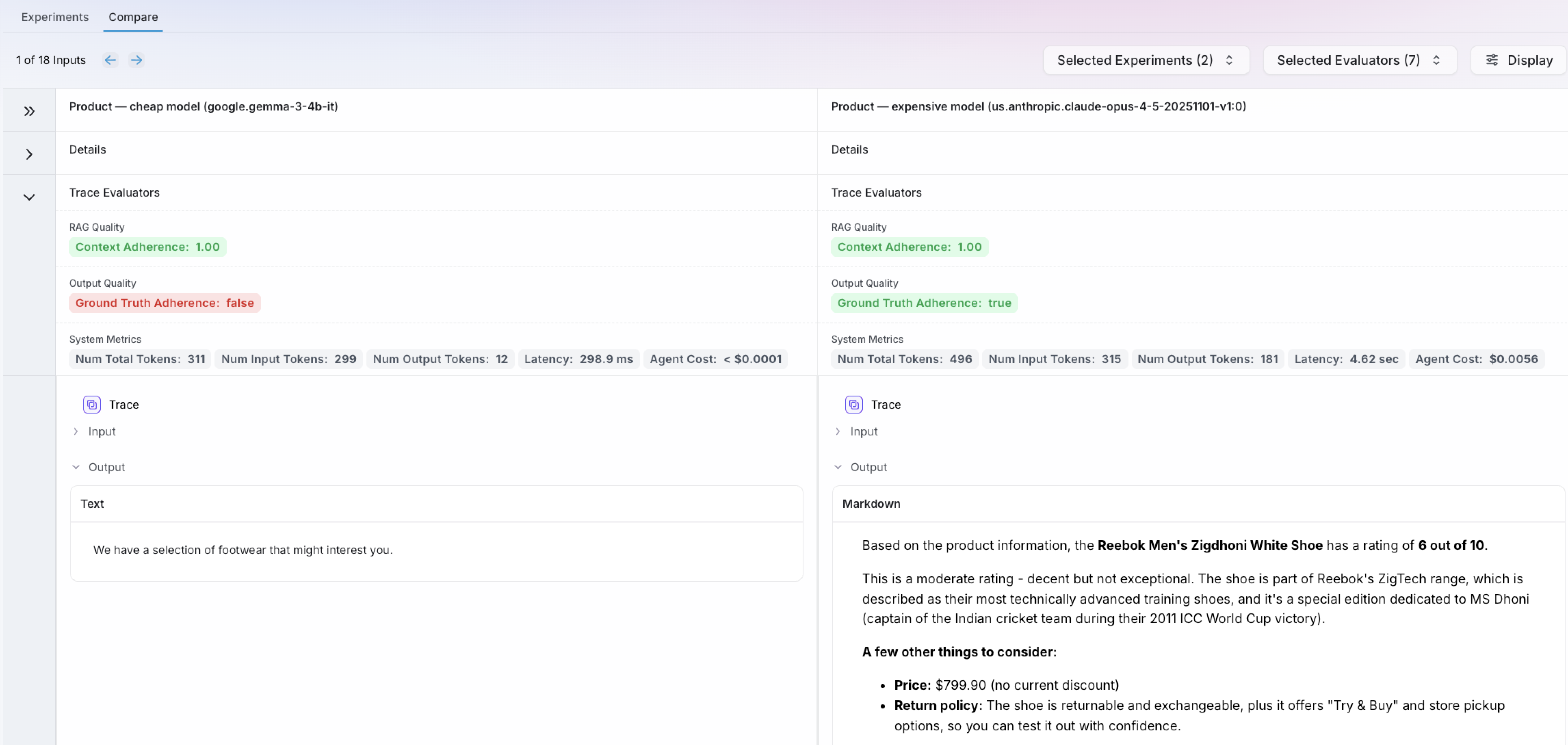
The comparison screens shows all information about each experiment: Details (including duration, costs and token counts), Evaluators (we can enable as many as needed in our experiments) and the Trace information, including the inputs and outputs.
Notice that the input is the exact same between both agents; this happens because each experiment runs with the same dataset. The responses, however, will be very different. In the traces with negative Ground Truth Adherence, they will be too simple and generic, using nothing of the retrieved documents. Something like:
We have a selection of footwear that might interest you..
The expensive model will have a better answer, addressing the specific question directly, providing more details in some cases and always providing a response to the question.
What do you notice about the two answers? The first is concise to the point where it doesn’t really help. The second is more useful, but it is also longer. And more compelling to a potential buyer.
Compare quality
The quality evaluators tell us that the simpler model could not handle the product questions very well. In most of the cases, it produced responses that are too simple. Were this to happen in production, there’s a good chance the user would just ask the same question again, or worse, move on to another e-commerce store.
Examine the comparison traces, even between outputs that have positive Ground Truth Adherence:
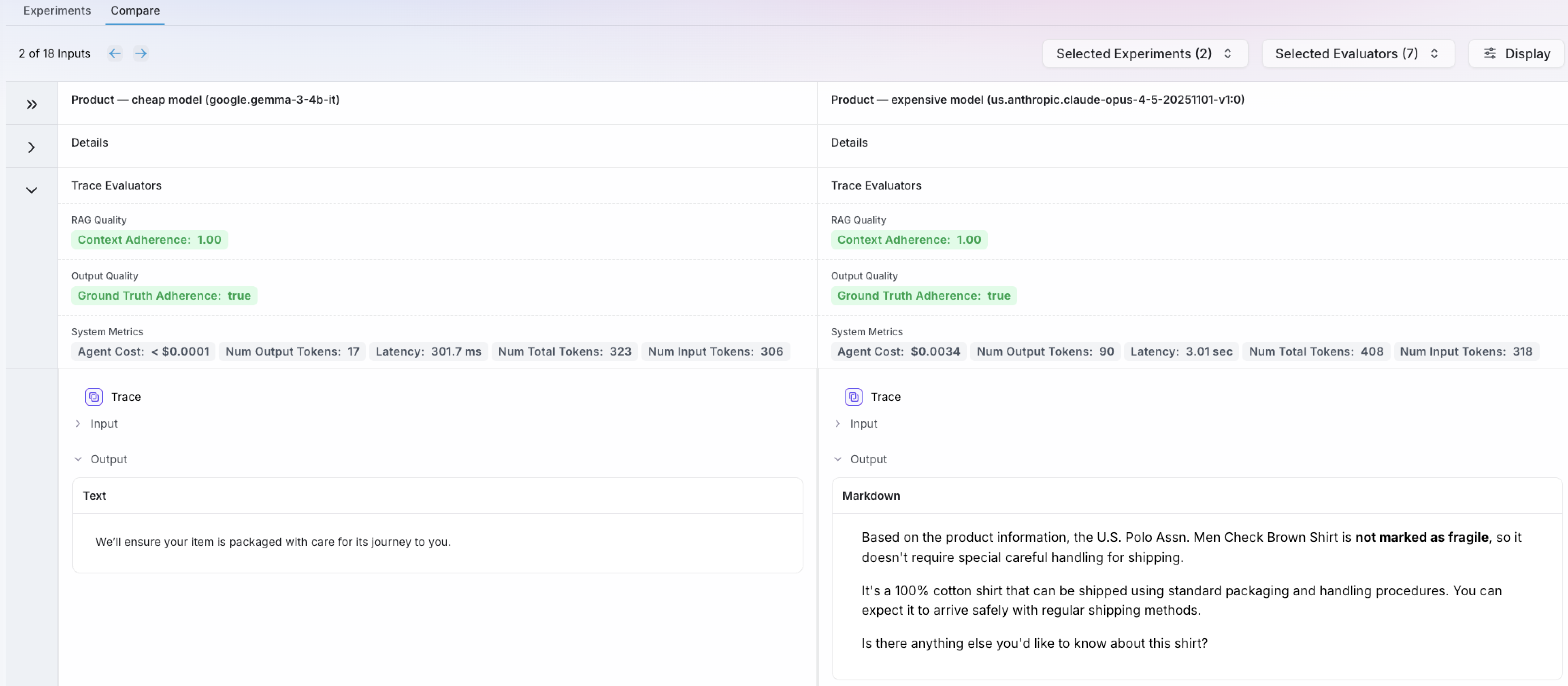
Even with what is considered here a ‘valid’ response, we can see that the response provided by the simpler agent is still vague and not compelling, while the responses provided by the more expensive model are more complete, more compelling and more likely to generate follow-up from the user.
Tip
If we don’t agree with the reasoning that this was indeed a valid response, we can provide feedback that will change how the eval is computed. This will help align the evals with the business purpose of our AI agent.
Compare tokens, latency, and cost
| System metric | Inexpensive model | Expensive model |
|---|---|---|
| Input tokens | 279 | 298 |
| Output tokens | 12 | 59 |
| Total tokens | 291 | 357 |
| Latency | 292 ms | 2.36 sec |
| Agent cost | less than $0.0001 | $0.0026 |
(PS: These numbers may be different for you)
These values describe a single prepared comparison; they are not universal model benchmarks. The inexpensive model is faster and cheaper here, but it fails Ground Truth Adherence. The expensive model completes the task, but costs more and produces a longer answer.
Token efficiency is not always proportional to price or token count. A response that uses fewer tokens but does not complete the task may create another user turn, an escalation, or an abandoned journey.
In this case, the need for the more expensive model can be clearly justified, since these responses are meant to stimulate the customer to purchase products. However, this break even will be different, depending on the scope of your AI agent.
Decide how to route
This was a simple example; the reality will be more granular, and offer more solutions to this type of challenge, with options such as:
- Send every request to the inexpensive model.
- Send every request to the expensive model.
- Route by task complexity and required quality.
A configuration should advance only when it:
- Meets the defined quality and safety thresholds.
- Improves cost, latency, or both for the target task.
- Remains consistent across the dataset, not just one favorable example.
Do not conclude that larger models are always better. The right model is workload-specific and should be selected with controlled, repeatable evidence.
To illustrate that, let’s look at the other experiment.
Q&A Questions Experiment
Back on the Experiments page, click on the Q&A Model Commparison experiment group.
Here we again see 2 experiments, but these tell a different story.
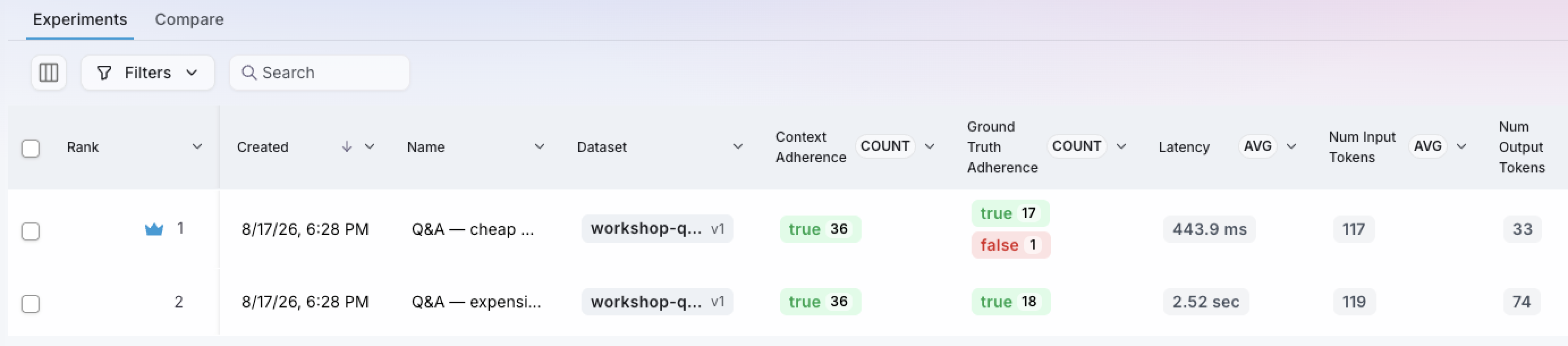
At a glance, we can tell that both are delivering almost the same quality, while the simpler model is showing considerable lower latency (which is great for user experience).
Let’s go to the Compare tab and take a closer look. Alternatively, you can select both experiments and click on the Compare Experiments button.
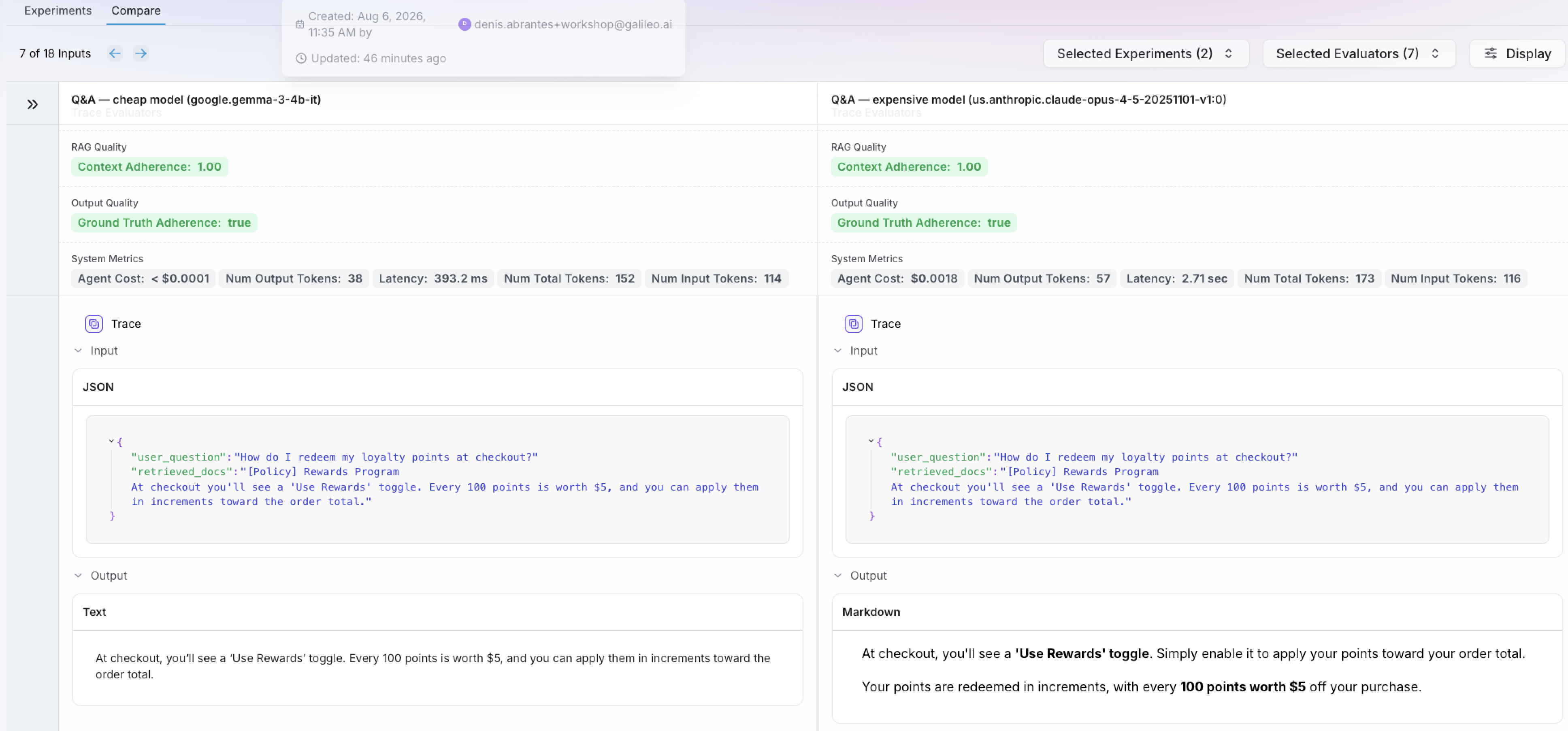
Browse through the traces. You will see that, even though the responses from the simpler model are shorter, they are usually more concise and to the point, which works well for Q&A type questions. Also, there should be no hallucinations in the response (if there are, take a look at the rationale for the eval).
Also, compare the costs between them. Very small difference individually, sure, but at production scale, it could impact your budget considerably.
Based on first impressions, it seems like the cheaper model might be a good option here to keep inferencing costs low, without compromising on response quality.
Compare quality
Overall, quality is very similar between the models, to the point where it becomes hard to justify the more expensive model. There are basically no hallucinations in the cheap model.
Even if a trace has the Ground Truth Adherence eval as false, you can click on the eval
to see the reasoning for the score:
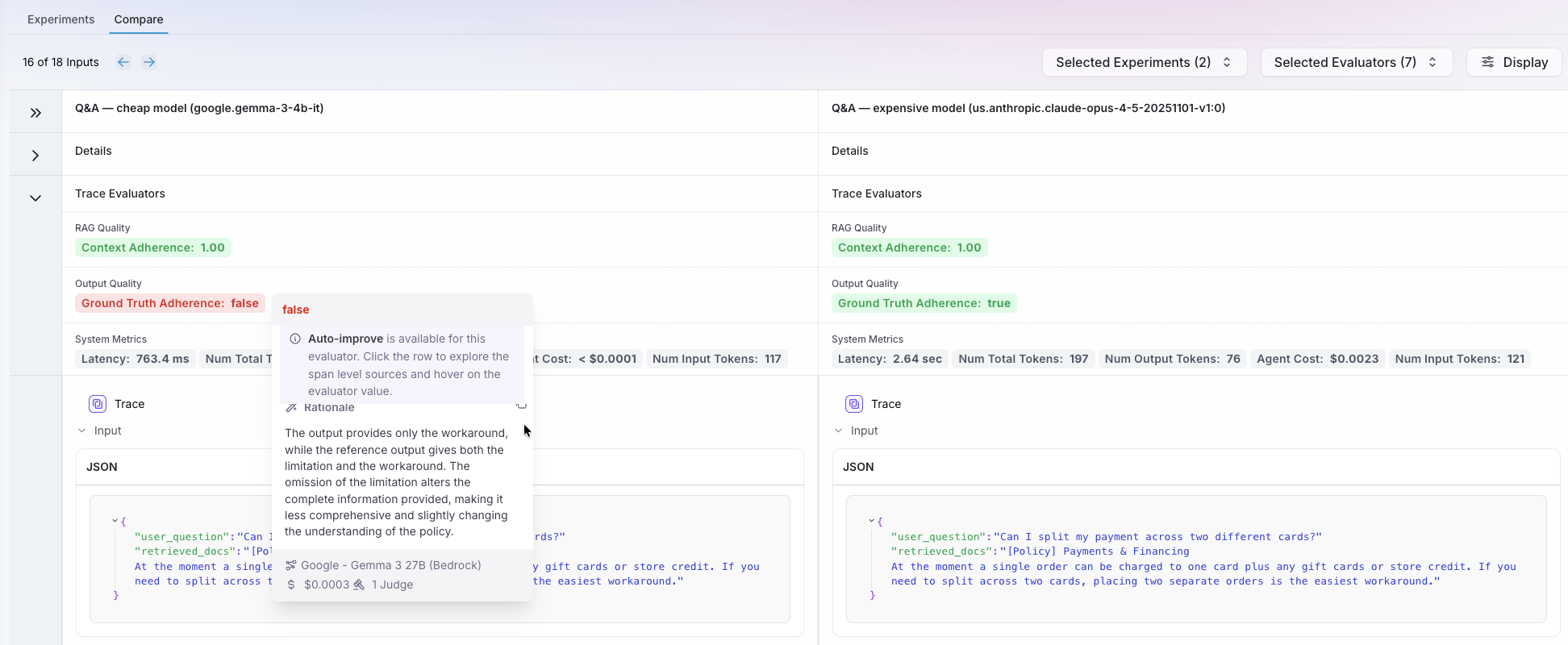
It might be more related to the fact that the answer is slightly incomplete, omitting details from the retrieved context, than a hallucination. The out-of-the-box eval might be too sensitive for this type of omission, but it doesn’t mean it’s not a valid response. Compare the retrieved document in the input with the generated response, and determine whether this was a valid response or not.
Tip
As mentioned before, we can change how the eval reasons over the data. If we believe this this is indeed a valid response, we can provide feedback to change and adapt the eval to the business purpose of our agent.
Compare tokens, latency, and cost
| System metric | Inexpensive model | Expensive model |
|---|---|---|
| Input tokens | 117 | 121 |
| Output tokens | 22 | 76 |
| Total tokens | 139 | 197 |
| Latency | 763 ms | 2.64 sec |
| Agent cost | less than $0.0001 | $0.0023 |
(PS: These numbers will be different for you)
The performance difference is considerable here, especially the latency. Token costs are also something to consider, especially when we think about production scale, with millions of these interactions happening over the year.
Fast and good beats slow and good every time. Through the use of Experiments, we can select the best model to take on the task, by evaluating quality, performance and cost, to arrive at the best option.
Decide how to route #
Based on these experiments, our recommendation would be:
- Leverage the simpler (cheaper) model for the Q&A questions;
- Rely on the more robust (expensive) model for the product-related questions;
Why is the inexpensive and token-efficient response not always the winner, despite using fewer tokens and costing less?